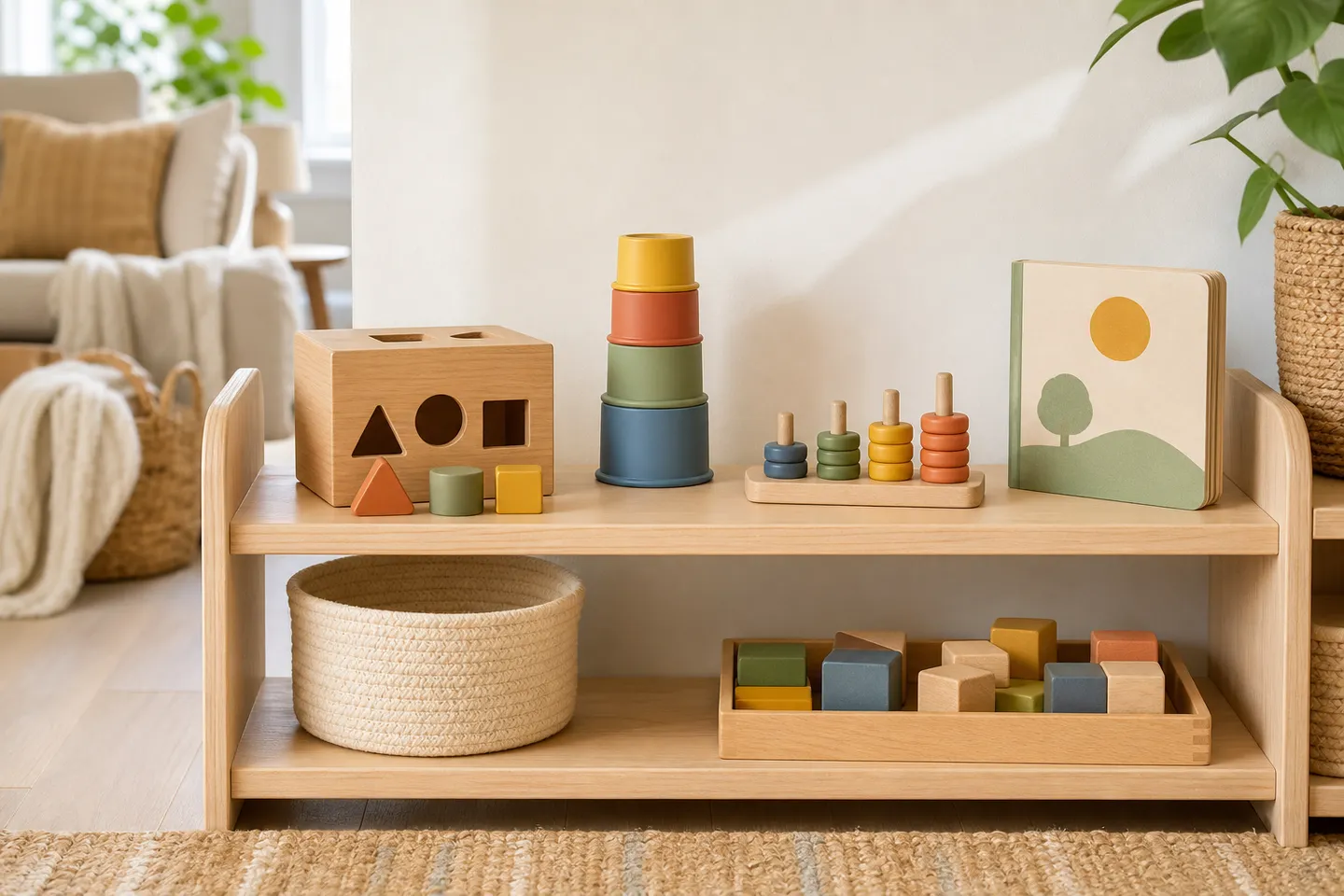
Parent question
Why Does My Toddler Ignore Their Toys?
A practical way to notice whether a toddler needs a simpler action, a new play role, or a smaller shelf instead of more toys.
Disclosure: Some links on this page are affiliate links. As an Amazon Associate I earn from qualifying purchases.
What may be happening
Are the toys uninteresting, too hard, or hard to start?
An ignored toy does not automatically mean the shelf needs replacing. The first action may be unclear, the pieces may be mixed together, or the toy may repeat a role that another favorite already fills.
What to observe
Look for the repeat.
Notice one activity your child chooses without prompting. Then compare an ignored toy: can they see how to begin, reach the pieces, and return to it after a simple reset?
Try this before buying
Make one smaller change.
Choose one familiar favorite and one different play role. Remove extra pieces, set up the first action, and offer a short period of play together. Repeat on another day before deciding whether to rotate or replace it.
Free shelf-reset checklist
Try this five-minute setup before buying anything.
- Keep one toy your child already chooses.
- Clear away close duplicates and mixed loose pieces.
- Add one different role: fill and empty, fit and match, build, or pretend.
- Show the first action once, then give the child room to try.
- At the end, note what was used, what was ignored, and what was difficult to reset.
What to do next: If a toy gets used after setup, keep the simpler invitation. If the child needs repeated help to begin, reduce the challenge. If another toy already fills the same role, rotate the duplicate.
If you can name a missing role, compare a sorter with an in-and-out toy or use the three-role starter shelf. For storage problems, begin with the small-space checklist.
Shortlist
 Fine motor
Learning Resources Spike the Fine Motor Hedgehog
Removable quills give toddlers a contained insert-and-remove activity with easy storage.
Why it fits: Useful when a child is ready to repeat grasp, place, and remove actions with a clear reset.
Practical tradeoff: Removable pieces need a reliable storage and cleanup routine.
Try before buying: Try a large, supervised container-and-lid activity with items too large to be choking hazards before buying a dedicated toy.
Listing-based research; not hands-on tested.
Buy on Amazon Shape sorting
Learning Resources Sunshine Shape Sorter
A compact sorter gives toddlers a clear matching task without a large footprint.
Why it fits: The visible shape-and-hole relationship gives a toddler one manageable problem to repeat.
Practical tradeoff: A sorter can frustrate a child who only wants an easy in-and-out action right now.
Try before buying: Use a small basket and a few large, clearly different household objects for a supervised matching or in-and-out activity first.
Listing-based research; not hands-on tested.
Buy on Amazon Open-ended building
Melissa & Doug Wooden Building Blocks (100 Piece)
A broad set of wooden shapes gives older toddlers room to build, arrange, balance, and make simple scenes.
Why it fits: Fits children who have moved beyond a few large blocks and want more choices for their own ideas.
Practical tradeoff: A large collection takes storage and sorting time; offer a small subset first and follow the current age label for the individual pieces.
Try before buying: Use a few blocks already at home or large empty boxes to try towers and bridges before adding a bigger block collection.
Listing-based research; not hands-on tested.
Buy on AmazonChoose the play role
Refresh the play role before replacing the shelf
Skip buying a new version of the same toy when the current shelf already has several similar actions.
What to look for
For this age range, favor activities with a clear starting point, a repeatable action, manageable pieces, and a storage plan. A toy can support practice without guaranteeing a developmental outcome.
How we review options
What earns a place on the shelf.
We focus on the toy's current fit, repeat play, and whether it works in a real home.
- Age fitCheck the current manufacturer age label and warnings.
- Play patternLook for sorting, posting, stacking, building, or pretend play that can be repeated.
- Parent practicalityConsider noise, cleanup, footprint, batteries, and how pieces are stored.
- Honest limitsWe do not claim hands-on testing, professional credentials, or a guaranteed developmental result.
What to consider
Choose for the job this toy needs to do.
Start with the kind of play your child is seeking and the limits of your home. Then choose one or two toys that fill different roles instead of buying several that do the same thing.
Before you buy
Use the current listing.
- Prices and availability can change.
- Confirm the current age label, warnings, and included pieces.
- Use the product page to check measurements and return details for your home.
Good next question
Would this toy still earn shelf space if it were used for only ten minutes at a time? That is a more useful test for a busy family than a long feature list.
Questions before you choose
Should I get rid of toys that are ignored?
Try a simpler setup or a short rotation first. Keep the useful favorites and avoid replacing the entire shelf based on one quiet session.
How do I know whether a toy is too hard?
Look for repeated difficulty with the first step, such as aligning a piece or pulling parts apart. Offer fewer pieces or a simpler action instead of insisting on the intended solution.
Will a new toy guarantee independent play?
No. Interest varies with the child and the day. Choose a clear starting action and a manageable reset, and use the shortlist only when it fills an identifiable gap.