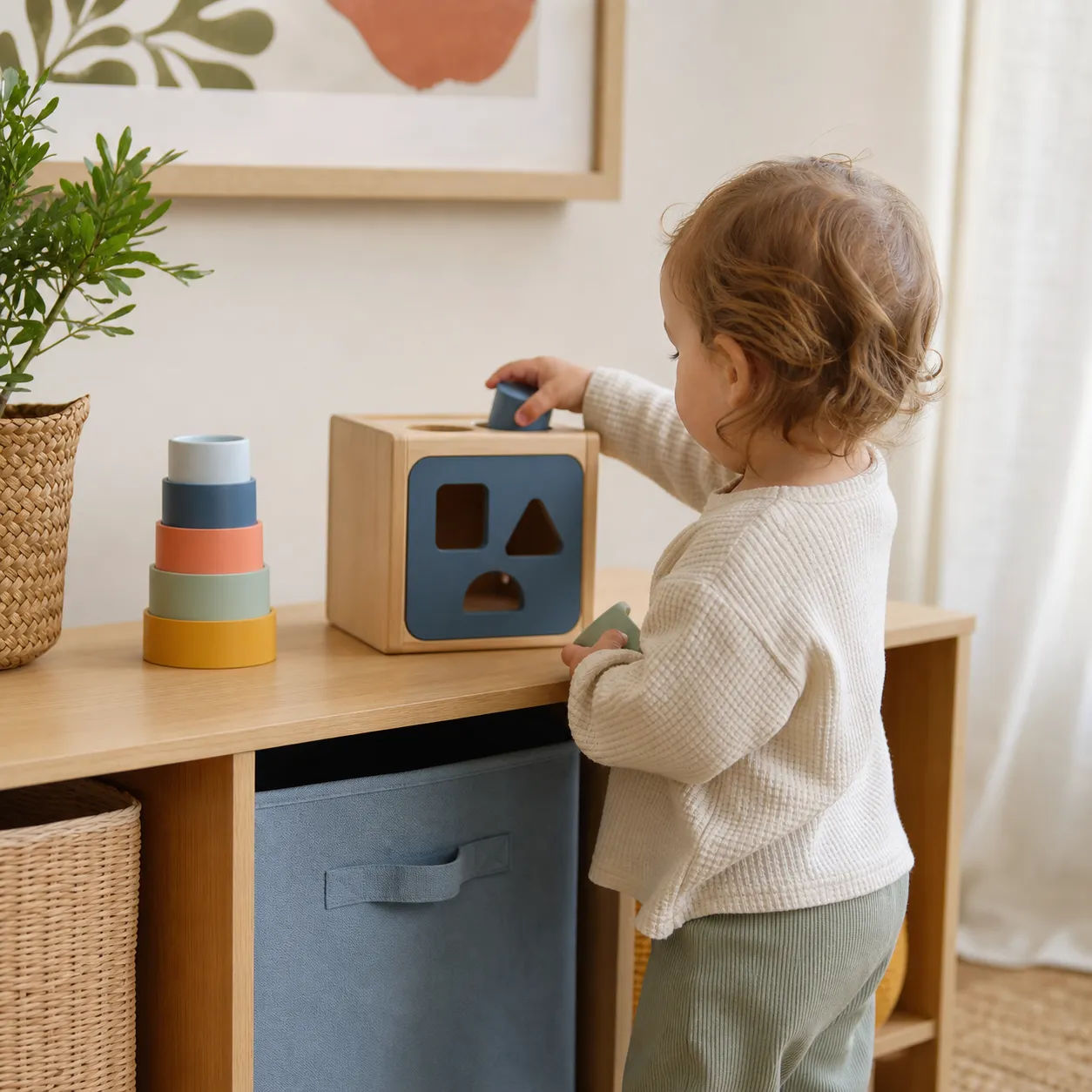
The first explorer
Toddler toys for 13-15 months
Communication, balance, and spatial awareness. Choose a small number of play invitations that feel appropriate now and leave room to grow.
Disclosure: As an Amazon Associate I earn from qualifying purchases.
What is changing now
Communication, balance, and spatial awareness
Many toddlers are pairing first words and gestures with more confident movement. Play can offer a simple action, a clear result, and time to repeat it.
How to choose
Choose two or three different play jobs.
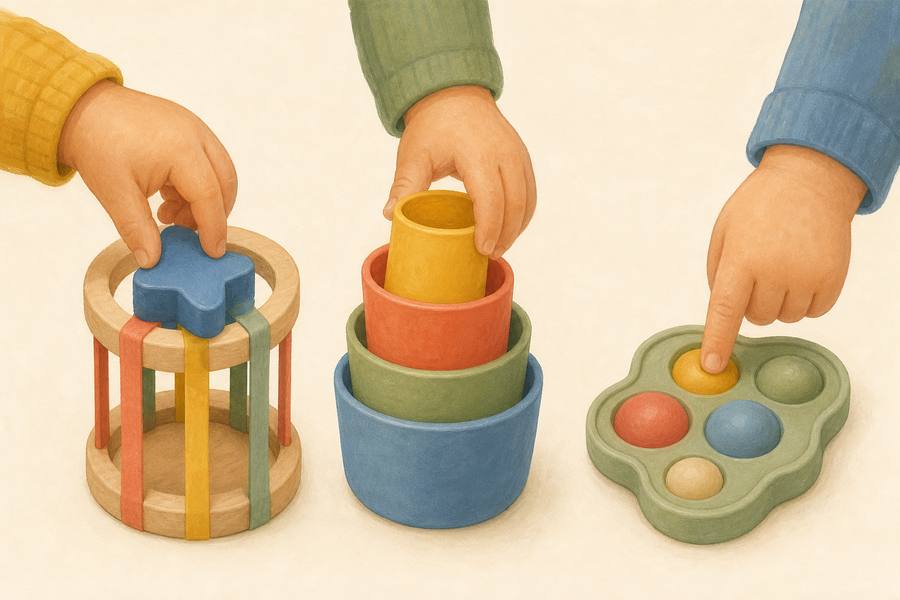
In-and-out play, tactile pushing, filling and dumping, easy carrying, and a small amount of open-ended nesting.
- Start with one clear action.Choose a toy the child can understand and repeat without a long setup.
- Add one flexible option.Keep room for carrying, filling, building, or pretend play as interests change.
- Skip duplicates.A new toy should add a new way to move, match, build, pretend, or solve.
The shelf for this stage
Six options, choose two or three.
These options serve different play jobs. You do not need every item on this page.
 In-and-out sensory play
Fat Brain Toys InnyBin
A flexible-band bin and chunky textured shapes invite toddlers to push, pull, and experiment without needing one correct solution.
Why it fits: A good early shelf option when a child is interested in putting objects in and taking them back out.
Practical tradeoff: Pushing through elastic bands takes more effort than dropping into an open bin; start with an easier container if the resistance frustrates the child.
Try before buying: Offer an open container and a few large, appropriate objects for supervised in-and-out play. This tests the interest, though it does not copy elastic-band resistance.
Listing-based research; not hands-on tested.
Buy on Amazon Tactile cause and effect
Fat Brain Toys Original Dimpl
Five silicone bubbles offer a small, quiet push-and-pop activity for focused hands.
Why it fits: Useful for a short, repeatable sensory action that is easy to carry and reset.
Practical tradeoff: The push-and-pop action is contained and portable, but it does not replace building, matching, or pretend play.
Try before buying: Try pressing a soft washcloth or squeezing a large sponge during supervised play; notice whether a repeatable hand action holds interest.
Listing-based research; not hands-on tested.
Buy on Amazon Open-ended stacking
Green Toys Stacking Cups
Cups can be stacked, nested, scooped, and used in water play.
Why it fits: One set supports stacking, nesting, filling, dumping, and water play as interests change.
Practical tradeoff: Cups are flexible but may feel less interesting if the child wants a clear matching challenge.
Try before buying: Nested food-storage containers or large cups can show whether filling, nesting, and dumping are the real interest.
Listing-based research; not hands-on tested.
Buy on Amazon Wooden shape sorting
PlanToys Geo Sorting Bucket
A 12-month-plus wooden bucket gives toddlers a contained shape-matching activity with chunky pieces.
Why it fits: A contained wooden option for shape matching, carrying, and putting pieces away.
Practical tradeoff: A sorter can frustrate a child who only wants an easy in-and-out action right now.
Try before buying: Use a small basket and a few large, clearly different household objects for a supervised matching or in-and-out activity first.
Listing-based research; not hands-on tested.
Buy on Amazon Cause and effect
Hape Pound and Tap Bench
A compact hammering activity supports repeated cause-and-effect play with supervision.
Why it fits: A repeatable action can help a child connect effort with a visible result; consider noise first.
Practical tradeoff: A hammering toy can be noisy and needs a stable surface and adult judgment.
Try before buying: Tap a wooden spoon on a sturdy container while you play together. Notice whether sound and striking are the attraction before adding a hammering toy.
Listing-based research; not hands-on tested.
Buy on Amazon Early building
Mega Bloks Big Building Bag (80 Piece)
Large blocks offer simple building and taking-apart play for young toddlers.
Why it fits: Large blocks invite a child to build, knock down, carry, and then try a new idea.
Practical tradeoff: A larger block bag can become clutter if only a small number of blocks are put out at once.
Try before buying: A few large blocks already at home can reveal whether building and knocking down are the useful next play role.
Listing-based research; not hands-on tested.
Buy on AmazonTry this before buying
Make the first shelf easy to enter.
- Start with one in-and-out activity.Let the child repeat a simple push, pull, or drop action before adding another toy.
- Keep nesting and stacking loose.Cups do not need to become a tower; filling, carrying, and dumping are useful play too.
- Leave the harder challenge nearby.Offer a sorter or tap bench once interest in the easier activity starts to fade.
Use the current listing: before ordering, confirm the current product, manufacturer age guidance, warnings, and availability on Amazon.